
Are Candidates Ready to Address Energy Shortages?
The campaign trail is about to be filled with contrasting visions of the nation’s energy future. While oil production and the ongoing debate about energy independence are sure to draw focus, the remarkably perilous state of the nation’s power grid and our supply of electricity have become kitchen-table issues.
Americans are rightfully frustrated with eroding grid reliability and ever-increasing power prices. Following a summer of rolling blackouts in 2020, a California state senator said, “today we have a grid that is increasingly expensive, unreliable and unavailable when people need it the most.” Those words foreshadowed what was coming for the nation.
While economy-wide inflation may be softening, electricity inflation is doing the opposite. According to the Bank of America, year-over-year inflation rate for U.S. electricity prices reached 5.9% in May, up from 3.8% in January. And there’s concern higher prices may be here to stay as power demand is beginning to surge.
In December, the North American Electric Reliability Corporation (NERC), which oversees the reliability of the nation’s grid, reported that “key measures of future electricity demand and energy needs are rising faster than at any time in recent years.”
NERC’s warning has already been overtaken by events. From battery manufacturing and semiconductor production to the nearly exponential growth of data centers underpinning the AI boom, industrial onshoring is driving explosive demand growth.
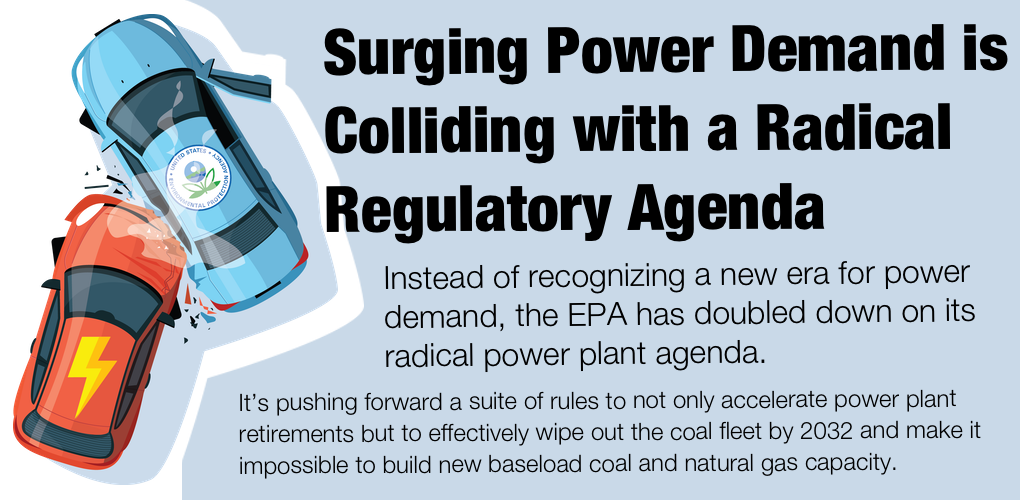
Surging Demand is Colliding with a Radical Regulatory Agenda
This soaring demand is now colliding with the rapid loss of essential dispatchable generating capacity. Remarkably, instead of recognizing a new era for power demand, the U.S. Environmental Protection Agency (EPA) has doubled down on its radical power plant agenda. It’s pushing forward a suite of rules to not only accelerate power plant retirements but to effectively wipe out the coal fleet by 2032 and make it impossible to build new baseload coal and natural gas capacity.
The nation’s utilities, electric co-ops and grid operators have sounded the alarm that EPA’s agenda is unworkable and that they’re going to be short of power. PJM, the operator of the nation’s largest wholesale power market serving 65 million Americans, is case in point.
Driven by EPA’s regulatory onslaught, PJM expects to lose at least 40 gigawatts of essential capacity by 2030 – perhaps far more – enough to power 30 million homes, while replacement generation isn’t materializing at the nearly the speed or scale the operator says is needed. PJM says it’s going to be in a deficit during periods of peak demand as soon as 2027.
The Next President Will Face an Electricity Crisis
What is happening in PJM is true across the country. And this electricity crisis will be a crisis for whomever is in the White House next.
Shortages of power and increasing electricity costs could place electricity supply handcuffs on the nation’s economy. Proposed manufacturing facilities – producing everything from semiconductors, batteries and cars – could struggle to find power. When they can’t, they simply won’t be built leaving investment, jobs and untold economic potential just sitting on the table. For consumers, ever-higher electricity prices would further eat away at disposal income, ensuring today’s stubborn inflation is anything but transitory.
This bleak future – one largely driven by the EPA’s regulatory agenda – is exactly the opposite of what Americans want. Recent national polling conducted for the National Mining Association (NMA) found that 72% of Americans are concerned about the speed of the energy transition’s impacts on reliability and 65% of Americans believe we should pause closures of existing, well-operating power plants until replacement generating capacity is in place and operational. This is up from 56% in May 2023, the last time the NMA polled on this question.
Americans don’t want power shortages and they certainly don’t want an energy crisis caused by irresponsible energy and regulatory policy. Candidates win by addressing kitchen table issues and a less reliable and increasingly expensive supply of power is decidedly one of them.
- On July 17, 2024