
PJM’s Power Crunch: Why Coal Is Critical to Closing a 60-Gigawatt Gap
As the data center boom advances, electricity grids across the country are scrambling to find new generation. While a growing number of data centers are turning to behind the meter solutions – proposing to generate their own power on site – regional grids are also facing a tsunami of new demand. Nowhere is that truer than PJM, the nation’s largest electricity market serving 67 million Americans stretching from Virginia to Chicago.
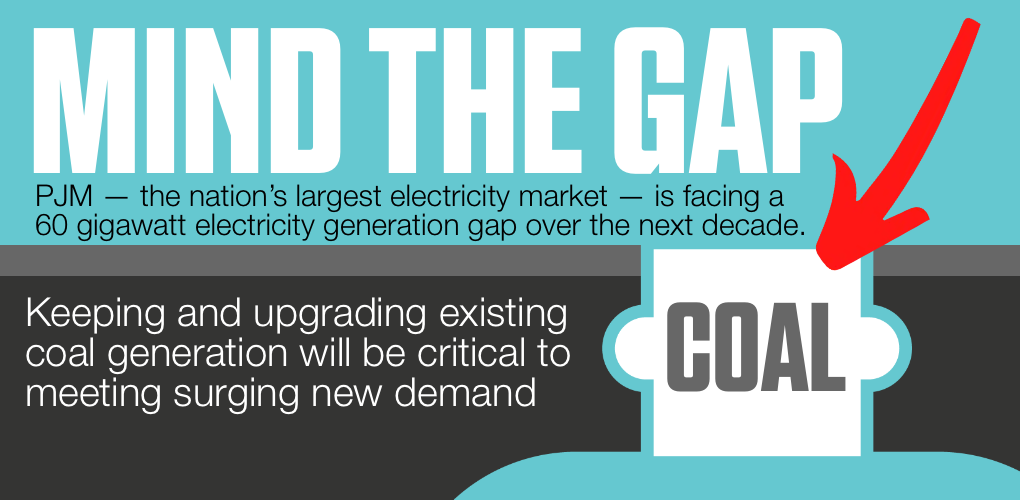
Once a grid reliability bulwark with deep reserve margins that often served as a lifeline for regional partners in periods of peak demand, PJM is now facing a multi-gigawatt supply shortage by the summer of 2027 that experts fear will balloon to 60 gigawatts over the next decade. It’s a supply gulf equal to the power needs of 45 million homes.
To help fill the gulf, PJM is seeking 15 gigawatts of new power supplies in an emergency auction. The auction requires new capacity which can be new builds, capacity additions to existing power plants, repowering deactivated generators as well as demand response and distributed energy resources. To be eligible, the projects must show they can be online by June 1, 2031, along with any enabling infrastructure.
It’s an aggressive timeline that is colliding with a host of challenges facing new generation, particularly new gas generation. If PJM hopes to meet these targets, coal power will be essential.
The Case for Coal
While delayed power plant retirements will not qualify for the auction, the loss of additional coal capacity in PJM will only make meeting soaring demand doubly difficult. Keeping existing coal capacity available is vital to closing – not expanding – the supply deficit.
Further, PJM notably counts capacity additions to existing power plants as well as repowering deactivated generators as eligible for the auction. Coal fits into both of these buckets.
In February, the Department of Energy (DOE) announced significant investments in six Appalachian coal plants to modernize, retrofit and extend their life—just the type of upgrades PJM is seeking. DOE’s 2027 budget request also targets repurposing $3.5 billion of Infrastructure Investment and Jobs Act funds to support reliable and affordable baseload power generation. According to the request, that includes coal power plant upgrades.
Whether procured directly through PJM’s emergency auction or used as foundational capacity to strengthen the market’s overall supply of dispatchable power, upgraded coal generation will be critical to meeting new demand.
Getting more out of existing capacity is nonnegotiable considering the mounting challenges facing new natural gas generation, as well as siting and completing new energy infrastructure.
The Gas Bottleneck
The hurdles to building and completing new natural gas pipelines and new transmission infrastructure – often so essential to renewable power additions – are well documented. Now, soaring costs and years-long waits for new gas turbines are adding towering new hurdles to an already deeply challenging situation.
According to recent analysis from Wood Mackenzie, gas turbines prices are expected to rise 195% from 2019 levels by the end of 2027. Not only are capital costs for new gas generation soaring, but even getting new turbines is proving increasingly difficult.
Wood Mackenzie noted that even as turbine manufacturers race to expand capacity, “specialized labor shortages, component bottlenecks… and ongoing trade-related cost pressures” are compounding challenges. A large gas turbine ordered today would likely take about five years to deliver. In other words, any newly proposed gas capacity additions wouldn’t even be available for PJM’s emergency auction; they simply cannot be delivered fast enough.
The power supply deficit facing PJM is illustrative of the deficit facing markets across the country. Generators and project developers are competing against each other for turbines, for skilled labor and for capital. Whether in PJM or out, increasing generation from existing dispatchable capacity is critical to meeting the soaring power demand sweeping the country. Today, getting more from the coal fleet isn’t optional—it’s become indispensable.
- On April 15, 2026