
Essential Dispatchable Capacity
While the lights haven’t yet gone out during this winter’s blast of bitter cold, Federal Energy Regulatory Commissioner (FERC) Mark Christie recently provided an important reminder of how utilities and grid operators are meeting record power demand.
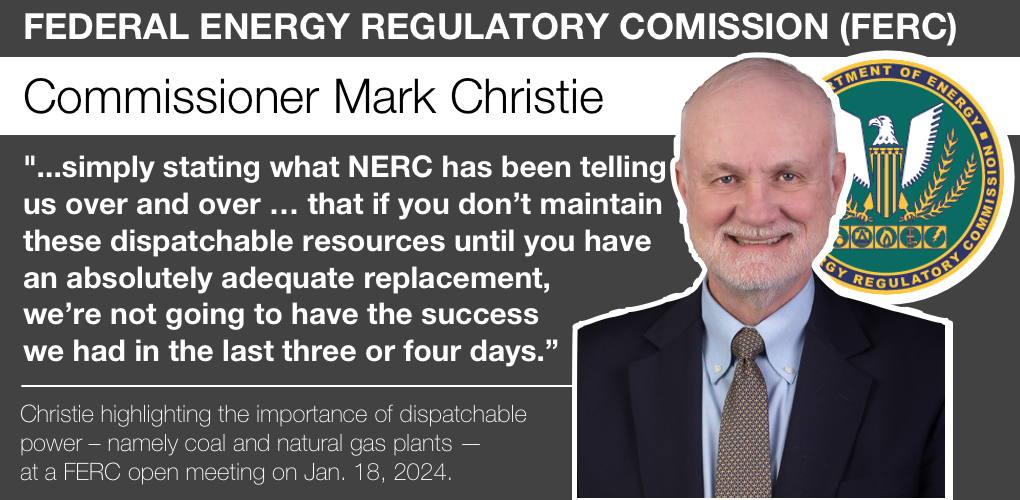
During a FERC open meeting last week, Christie reminded all in attendance that it’s dispatchable power – namely coal and natural gas plants – doing the lion’s share of work. And these same essential plants are also the target of the U.S. Environmental Protection Agency (EPA)’s regulatory blitz.
Christie pointed out that during periods of peak demand, coal, gas and nuclear power provided 90% of available generation on the PJM grid, the nation’s largest. On the MISO grid, coal, gas and nuclear power met 80% of peak demand. Coal generation regularly met more than 40% of power demand on the MISO and SPP grids during the coldest hours of the deep freeze.
Christie underscored that these numbers highlight the danger posed by the loss of dispatchable generation without adequate, reliable replacements.
“If the pace of retirements continues at the pace it is, the numbers just aren’t going to add up,” Christie said. “This is not a commentary against some form of resources. It is simply stating what NERC has been telling us over and over … that if you don’t maintain these dispatchable resources until you have an absolutely adequate replacement, we’re not going to have the success we had in the last three or four days.” His full remarks, available here, are worth a watch.
The Retirement Risk
In December, the North American Electric Reliability Corporation (NERC) warned in its Long-Term Reliability Assessment that the planned retirement of 83 GW of fossil and nuclear generation over the next decade creates blackout risks for much of the country. Alarmingly, that report and those retirement projections may be far too conservative.
The EPA has made it abundantly clear it hopes to force the accelerated retirement of the majority of the nation’s coal fleet by 2035 and is targeting the vast majority of both the coal and gas fleets – fully 60% of the nation’s generating capacity – with its so-called Clean Power Plan 2.0.
NERC, for its part, warned in its long-term assessment that, “Environmental regulations and energy policies that are overly rigid and lack provisions for electric grid reliability have the potential to influence generators to seek deactivation despite a projected resource adequacy or operating reliability risk.”
NERC, FERC, the grid operators and the utilities have all but run out of ways to warn policymakers that the nation’s imploding grid reliability – and the risks posed by bad policy – require an urgent course correction.
The very sources of generation we count on again and again to keep the lights on and homes warm when other sources of power falter are being irrationally forced off the grid while the very people who understand grid reliability best are begging to keep them online.
There should be no consolation in grid reliability holding up so far this winter. Grids across the country are more stressed than ever while operators are watching the tools they need to keep the lights on disappear. Fuel-secure, dispatchable power is a necessity we can’t do without. It’s far past time EPA recognizes it.
- On January 22, 2024