
Coal Remains the World’s Leading Fuel for Electricity Generation
The world needs U.S. coal technology leadership more than ever. And if the U.S. is indeed concerned with tackling the global emissions challenge, coal technology can’t be an afterthought in the climate equation, it needs to be a centerpiece of the effort.
The 2020 BP Statistical Review of World Energy highlights a trend that is only growing more pronounced by the year. While coal consumption is waning in the U.S. and Europe, it’s growing even faster in Asia. Coal remains the world’s leading fuel for electricity generation and the key input to produce the vast majority of the world’s steel.
The following chart from Axios, produced from BP data, is telling. While American climate hawks see an emissions-reduction silver bullet in pushing the U.S. coal fleet off the grid – regardless of the cost to grid reliability or energy affordability – U.S. coal consumption is but a small part in a far larger drama.
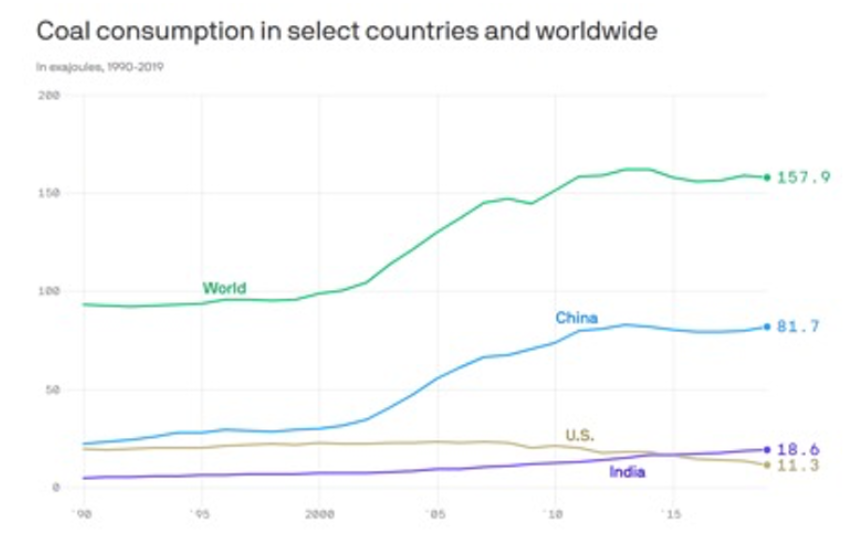
China is consuming more coal than the rest of the world combined and continuing to add new plants both at home and abroad. According to recent analysis, China may add another 130 gigawatts of coal-fired generating capacity over the next five years.
In India and Southeast Asia, coal’s story is also a bullish one. The International Energy Agency (IEA) reported in December that in India coal generation is expected to grow by 4.6% per year through 2024. That growth isn’t coming in place of investment in renewables but right alongside it.
In Southeast Asia, coal’s growth is even more pronounced. Coal demand is expected to grow by more than 5% per year through 2024, led by Indonesia and Vietnam.
Shirley Zhang, an analyst at energy consultancy Wood Mackenzie, recently told Bloomberg, “The future of coal depends on Asian demand, which is still growing, and is offsetting the decline from the rest of the world over the next decade.”
Today, Asia accounts for 77% of global coal demand. By 2030, according to IHS Markit, it will reach 81%.
This is a reality – this is data – that must inform and hopefully shape the ways in which the U.S. invests in energy technology and emissions reduction technology. The very environmentalists who have worked tirelessly to try and kill the U.S. coal fleet should be begging for the Department of Energy and the nation’s national labs to work on the advanced coal and fossil fuel technologies that address emissions from the fuels the world uses and will continue to use well into the future. Coal may no longer be king in the U.S., but it remains firmly atop the global throne.
America cannot – nor should it even consider – turning its back on the U.S. coal industry, the expertise of a workforce second-to-none and the world’s largest coal reserves.
Testifying in front of the Senate Energy and Natural Resources Committee earlier this year, when asked which technology is most essential to reducing emissions, IEA Director Fatih Birol said, “If I had to pick one technology as the most critical, if I had a magic touch to make this technology mature and [gain] market share,” it would be carbon capture.
Developing and deploying the essential coal technologies of tomorrow here in the U.S. isn’t something we should just hope to do, it’s an imperative. Advancing the CoalFIRST program, which is aiming to develop next-generation, near-zero emission coal plants, fits that bill. Extending the 45Q tax credit for carbon capture also must be part of the equation. The world needs a breakthrough in carbon capture, utilization and storage technologies and it needs U.S. leadership to get it done.
Confronting the global emissions challenge will not be won with more production tax credits for mature wind technology. It will be won developing and advancing new, essential energy technologies that work with the energy infrastructure the world has and will continue to lean on for decades to come.
- On June 24, 2020