
An Essential and Irreplaceable Industry Now and Tomorrow
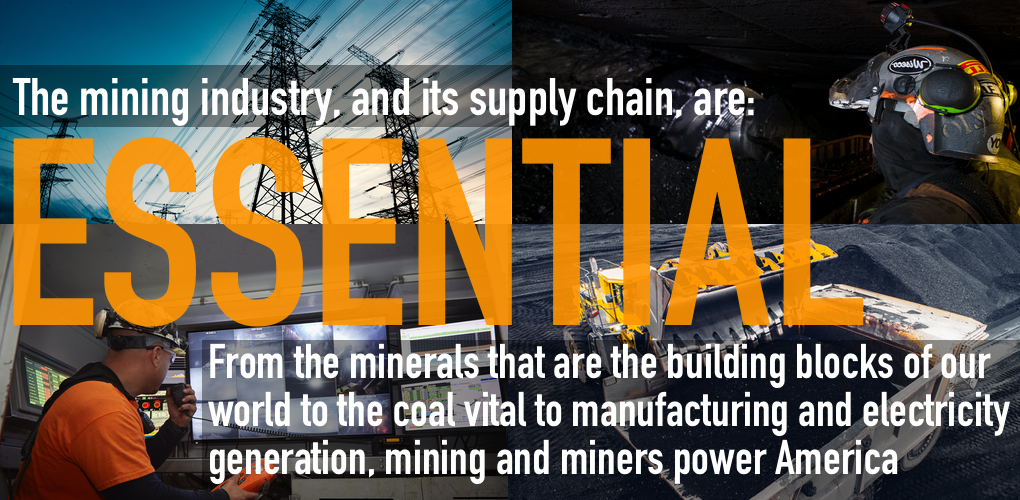
Just this weekend, the Department of Homeland Security (DHS) reiterated the obvious: the mining industry, and its supply chain, are essential. From the minerals that are the building blocks of our world to the coal vital to manufacturing and electricity generation, mining and miners power America.
DHS explicitly included mining in its list of 16 critical infrastructure sectors that should maintain their work schedules to help the response to the coronavirus outbreak. NMA’s president and CEO, Rich Nolan, said of the inclusion, “Our nation needs stability right now. We need a dependable supply chain for our manufacturing sector. And we need to know that our power sector is secure across the country. Mining underpins every aspect of our economy.”
The nation’s vast coal reserves and our robust mining industry remain the foundation for our affordable, balanced and reliable electricity portfolio. As global supply chains breakdown, the security offered by coal provides welcome system-wide resilience.
Critics of the industry have asked just how essential coal power and mining are to a country promised a wind and solar utopia. The answer is very, not only for the country as a whole, where coal generation supplies a quarter of our power, but in particular for a multitude of states where coal remains the workhorse fuel for electricity generation. Even in states where coal isn’t the dominant fuel, it continues to play a largely unheralded but essential role in providing grid reliability when times get tough.
The on-site fuel security and dispatchability of the coal fleet has proven invaluable time and again during bitter cold when other sources of power couldn’t rise to the occasion. The key role coal has played during polar vortexes and bomb cyclones is one it can play in other challenging circumstances. While it hasn’t yet been forced to take on the role, should a major pipeline go down to a cyber attack or the nation’s energy workforce become perilously stretched during some kind of other emergency, maybe even a pandemic, fuel-secure coal generation can be the glue that holds the system together.
Following weeks of social distancing, it’s safe to say we are now living in a new world where the unlikely or the unthinkable is reality and concepts like resilience, reliability and security in our critical infrastructure seem more important than ever. We’ve also crossed into territory where the singular proposition of least-cost power determining our energy mix should be viewed as grossly outdated. Markets – and market constructs – must better account for balance, security, reliability and resilience to ensure the electricity mix of tomorrow is the mix we need. This is all the more reason the coal industry deserves smart, targeted support to ensure it can come through this crisis stronger than ever.
There will be – and already are – many essential industries that are going to face profound challenges in the months ahead as this crisis evolves. With much of the country in lockdown, energy demand will be affected and there will be added pressure placed on already undervalued coal plants. Some mines will have to make tough choices about idling production, or worse, to respond to extraordinary market conditions. These near-term conditions cannot be allowed to define the nature of an industry or the balance of the nation’s electricity mix.
Smart policy in response to this moment will be built upon the energy needs of tomorrow, not the unique circumstances of today. It will ensure essential pieces of infrastructure keep running, essential workers stay employed and that when energy demand does return to pre-crisis levels, or even higher as the push for economy-wide electrification builds steam, we have the power capacity and workforce needed to meet the challenge.
Coal generation has taken on a role as guarantor of reliability and resilience. It’s a role no other player is prepared or capable of stepping into. In this extraordinary moment, when energy markets are being turned upside down, policymakers must make sure that the undervalued and irreplaceable doesn’t slip through the cracks. If smart action isn’t taken, we may tread water in one crisis only to lurch into new crises we had the means to avoid.
- On March 31, 2020