
Understanding Global Trends, Voters Want the U.S. to Lead on Coal Technology
In
one of the most developed economies on earth, a place synonymous with advanced
technology, coal isn’t on the way out; in fact, its role is growing. As The New York Times
reported this week, Japan is building 22 new coal plants over the next five
years.
For Japan, advanced coal plants mean energy security and affordability. And,
rather than coming in the way of emissions reduction efforts, they are part of
them. More efficient, using less coal to generate even more power than the
older plants they will eventually replace, Japan’s new coal units will be the
foundation for its advanced energy economy.
Japan’s embrace of coal has caught some by surprise, but it’s hardly an
outlier. As the International Energy Agency has reported, coal remains the
world’s leading fuel for electricity generation and global coal consumption is
expected to increase for at least the next five years. Japan’s new plants will
join hundreds of others in dozens of nations expected to come online this
decade. Coal’s role maybe shrinking in some places, but it remains the world’s
workhorse fuel to provide affordable, secure energy.
American voters seem to understand what some politicians do not. Coal is a
global fuel, and the U.S. needs to take a leadership role in developing and
deploying advanced coal and emissions-reduction technologies.
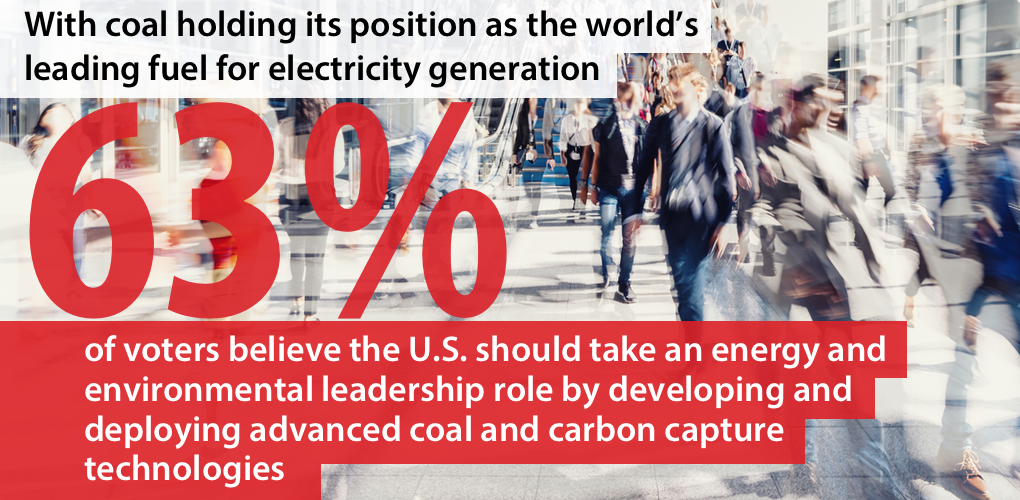
Asked in a recent poll whether the U.S. should take that
global leadership role, 63 percent of respondents said yes; just 11 percent
disagreed, with the remainder not offering an opinion.
The same poll found that Americans are still strongly behind an
all-of-the-above energy approach. Seventy-two percent of respondents believe
it’s important to keep a balanced electricity mix that includes coal, natural
gas, renewables and nuclear power.
Of course, what Americans want – whether it’s a leadership role in developing
and deploying advanced coal and carbon capture tech or maintaining a balanced
electricity mix – is not what we are hearing and seeing from most presidential
candidates. That’s unfortunate for any number of reasons but it’s particularly
troubling because it’s also out of sync with the approach experts tell us we
should take.
The International Energy Agency has made it clear that advances in carbon
capture are absolutely essential. Advanced energy and emissions-reduction
technologies that focus on the fuels the world uses, and will use, must be
centerpieces of any effective and replicable approach to cutting emissions, not
after thoughts.
In an event just this week in Washington, the Global Carbon Capture and Storage
Institute reported that there are 19 operating facilities worldwide that can
capture, compress, transport and store CO2. Several dozen more
facilities are under construction or in development but this effort is just a
fraction of what’s needed. According to the Institute, 2,000 carbon capture
facilities must be up and running by 2040.
Voters understand the role the U.S. must play in pursuing advanced energy and
emissions-reduction technologies and the place coal and carbon capture
technology must hold in that effort. It’s about time policymakers – and
presidential candidates – get the picture as well.
- On February 6, 2020