
Building a Better Future from West Virginia to India
The world’s population is racing towards 10 billion by 2050. It’s an astounding number that has huge implications for global energy use but also for material needs. As populations grow, urbanization is growing as well. A higher and higher percentage of us are living in cities.
The United Nations reported last year that 55 percent of the world’s population now lives in urban areas and that proportion is expected to reach 68 percent by 2050.
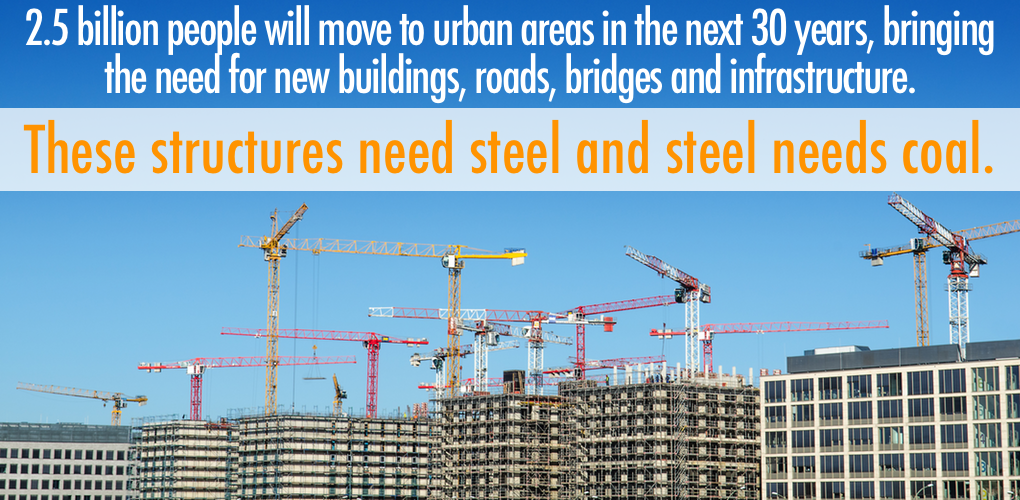
Just how fast is global urbanization happening? Consider that in 1950 the global urban population was estimated to be 751 million. In 2018, it exceeded 4.2 billion. Another 2.5 billion people will move into urban areas in the next thirty years.
With urbanization comes the need for new buildings, new roads and bridges, water supply and treatment facilities, and the myriad other pieces of critical infrastructure we rely upon. These structures need steel and steel needs coal. More than 70 percent of the world’s steel is produced with coal.
While thermal coal used in power plants to generate electricity grabs more attention, the market for metallurgical coal, or coking coal, a higher grade of coal used for steel making, is particularly strong. Global steel demand continues to grow, and American mines and miners are playing a key role in meeting it.
On February 14th, Valentine’s Day, Arch Coal announced the development of a new metallurgical coal mine in northern West Virginia. The new mine complex will be called Leer South and production is expected to begin in 2021. Once fully operational, the mine will directly employ nearly 600 West Virginians and many times that number indirectly. In announcing the news, Arch pointed to strong demand for metallurgical coal in India and other Asian economies where steel demand and production is growing rapidly. India is leaning heavily on metallurgical coal imports to fuel its urbanization.
While India’s urban population is soaring – think of megacities like New Delhi or Mumbai – the World Bank reports that less than 35 percent of India’s more than 1.3 billion people are living in urban areas. Driving further urbanization will be key to India’s efforts to tackle poverty.
Cities, particularly in developing nations, offer improved access to energy, healthcare, education and economic opportunity. As Jude Clemente pointed out in an insightful column for Forbes, China is case and point for leveraging urbanization to reduce poverty. Between 1981 and 2004, China lifted more than 600 million people out of poverty and rapid urbanization played a central role.
To address poverty and build the cities of the future, the world needs affordable, reliable power, and steel to build, create and connect. America’s coal industry is ready to provide it.
- On February 22, 2019