
California’s Regressive Lab Experiment
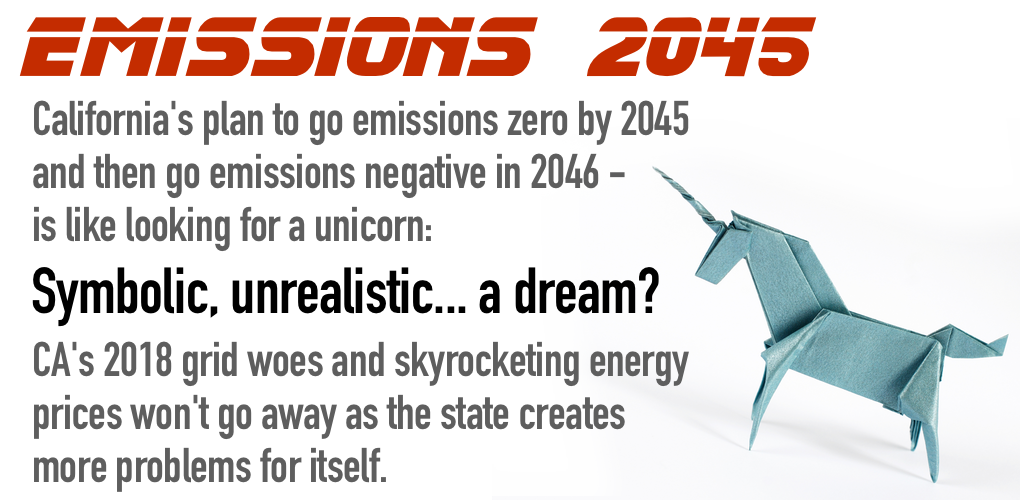
Responsible governance is defined differently in California. Governor Jerry Brown has signed an executive order for the state to slash its overall emissions to zero by 2045 and then go negative, meaning that in 2046 the state will have to start pulling more emissions from the atmosphere than it puts in. As a compliment to this policy, 100 percent of the state’s electricity must be generated with carbon-free sources by 2045. What this will cost, no one has the slightest idea.
Vox’s David Roberts, an uber climate hawk, described these executive orders like this: “Wait, whaaat? Zeroing out carbon entirely in California? In just over 20 years? In my expert opinion, that is … holy ####.”
Californians – well at least some of them – realize that the state can’t singlehandedly win the global fight against rising emissions. California’s effort is going to be largely symbolic, or inspirational, depending on your preferred adjective.
Besides being almost certainly technically infeasible with current technology, it’s going to be awesomely expensive, perhaps ludicrously so. There has been a startling lack of curiosity in even exploring the costs. No projection was included with the executive orders. In the Governor’s defense, it’s hard to put a price tag on technologies that don’t exist. There are so many variables at play here, even trying to model the costs is likely a fool’s errand. However, vast uncertainty aside, what we do know is that the policy is without a doubt regressive and it should shake consumers’, seniors’ and anti-poverty advocates to the very core.
As The Wall Street Journal pointed out, electricity prices in California are already by far the highest in the western U.S. Electricity prices have jumped 25 percent since 2013 as California has plunged headlong into its renewable energy crusade. While wind and solar power are becoming increasingly cost-competitive, the burden of integrating them onto the grid is getting more difficult and costlier.
As California has ramped up its use of solar power, it’s already facing the growing hurdle of an increasingly severe “duck curve” and the challenge it poses to grid reliability. Pushing even more intermittent generation onto the grid, while intentionally phasing out existing sources of dispatchable power, is a recipe for trouble. California is gleefully creating all its own problems while crossing its fingers for huge breakthroughs in energy storage to come to the rescue.
Deciphering the relative successes, or failures, of this great gamble is going to be a challenge unto itself. Proponents of California’s renewable push are already defensive about their sky-high electricity prices. As they will tell you, California’s average residential electricity expenditures are some of the lowest in the country. That, of course, has nothing to do with sound energy policy but everything to do with a temperate climate which results in Californians simply using less energy. Transplant California’s electricity prices to Georgia or Ohio, for example – where consumers are forced to run their AC or heat pumps far more often and where heavy industries need affordable power – and those costs would be economy crushing.
It’s not terribly difficult to already argue that California’s sky-high electricity prices are already an economic drag. Thanks to low-cost energy nearly everywhere else, manufacturing investment is returning to the U.S., but that’s not the case in California. Manufacturing employment has grown half as fast in California as it has nationwide since 2010.
California is building a grid for the elites. The cost of this moonshot is going to fall disproportionately on those that simply can’t afford it, and they have been given no choice but to weather the storm as best they can. As this effort runs into headwinds and the costs mount, don’t expect Californians to admit their mistake. Too much political capital has been invested in placing this albatross around the state’s neck.
As California inevitably tries to export its great gamble to other states, asking everyone else to try the Kool-Aid, we should be very careful to read between the lines. Energy policy is too important to be turned into a lab experiment. The diversity of our grid is the foundation of its affordability and reliability, as well as the foundation of the nation’s economic well-being. Achieving environmental progress should be just one dimension of sound policy, not the only dimension.
Before betting the grid on technologies that don’t exist, a more productive step would be betting on those that do: advanced coal technologies broadly in use around the world that sharply reduce emissions and increase efficiency. A grid that is at once diverse, reliable, affordable and environmentally responsible should remain our focus.
- On September 12, 2018