

Answering the Grid Reliability Call
Winter’s bite has arrived. Much of the country is already facing a polar blast and regional electricity grids are ramping up generation to meet high demand. Electricity prices in some regions are already soaring. But not everywhere. Notably, there’s a sharp divide emerging on affordability between the grids that have access to coal generation and those that don’t.
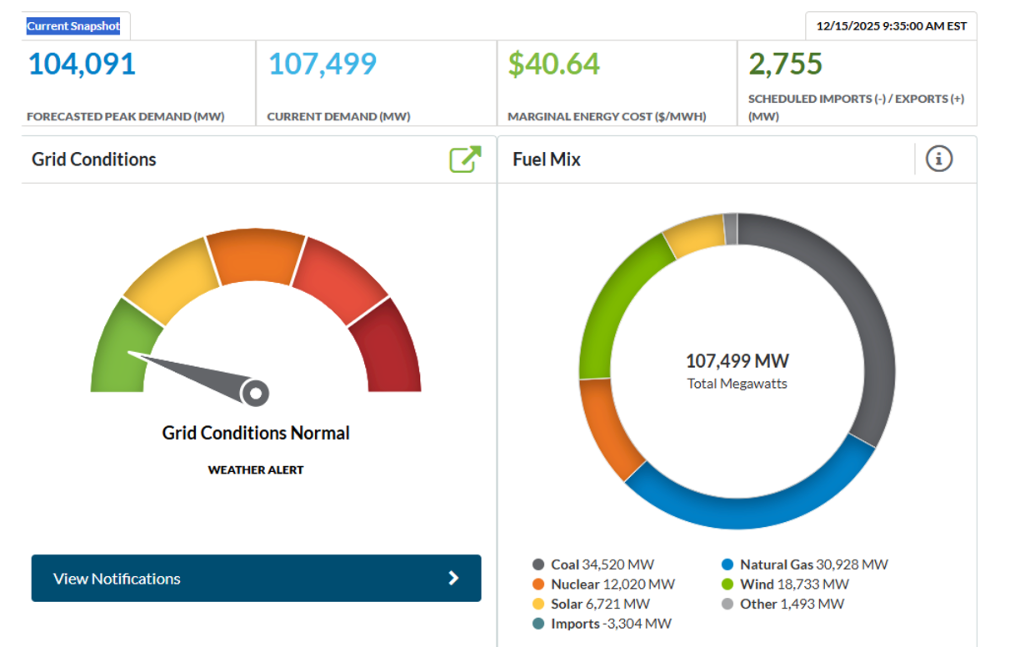
Consider the price of power Monday morning as bitter cold gripped a large swath of the country. Prices in New England and New York soared while prices on the PJM grid and, notably, the MISO grid, largely shrugged off the cold (see the chart below from https://www.gridstatus.io/).

On the MISO grid – the only of the four where coal capacity still shoulders the majority of winter power demand – prices remained remarkably low.
For both energy affordability and grid reliability, dispatchable fuel optionality is key. The lack of optionality in New York and New England – where both grids have eliminated their coal capacity and are stuck with deeply constrained natural gas supplies – is proving a woefully expensive mistake.
The coal capacity available on both the PJM and MISO grids is a regional and national power supply stabilizer and price shock absorber. The availability of that capacity to ramp up generation and reduce the burden on other sources of energy – especially when natural gas demand soars from heating – is critically important. That optionality is saving consumers billions of dollars and has repeatedly proven a grid reliability backstop — a backstop we’re unfortunately sure to need this winter.
Jim Robb, president of the North American Electricity Reliability Corp. (NERC), recently called the nation’s grid reliability a “five-alarm fire.” And NERC’s winter reliability assessment, which found grids across the country alarmingly short of dispatchable capacity during peak winter power demand, underscores the concern.
While the Trump administration is working diligently to bolster the nation’s dispatchable capacity – with a flagship piece of that effort ensuring we don’t see any more misguided closures of essential coal plants – Congress also has an important opportunity to help address the nation’s reliability crisis.
Congressional Opportunity
Two bills offer critically important answers and deserve strong bipartisan support. H.R. 3632, the Power Plant Reliability Act, introduced by Rep. Morgan Griffith of Virginia, and passed by the House this week, zeroes in on a key vulnerability in our power system: the inability of federal regulators to step in when utilities or power markets are failing their reliability mandate.
The Power Plant Reliability Act gives the Federal Energy Regulatory Commission (FERC) the authority to intervene when premature plant retirements threaten grid stability, and it also requires plant owners to give five years notice before closing plants—providing the time and transparency grid operators need to plan for reliable replacement capacity.
H.R. 3616, the Reliable Power Act, introduced by Rep. Troy Balderson of Ohio, provides a commonsense safeguard against federal regulations that could compromise reliability — a direct and important response to the prior administration’s reckless regulatory overreach. The bill requires FERC to review proposed regulations from federal agencies that could compromise reliability on grids already facing power supply emergencies. While the need for this kind of legislative fix may seem too hard to fathom, a regulatory onslaught designed to wipe essential dispatchable capacity off the grid despite countless reliability warnings was exactly the scenario that played out under the Biden administration’s watch.
With power demand only growing at a remarkable rate, the need to prioritize grid reliability by reprioritizing dispatchable power is an urgent one. The challenges facing grids across the country are daunting, but the obstacles ahead only loom larger. As power supply reserve margins shrink and as power demand soars, the room for error is growing perilously thin. Smart legislation that tackles the reliability crisis couldn’t be timelier.
- On December 17, 2025