
The Affordability Crisis Is a Reliability Crisis
Soaring electricity prices have become a top-tier political issue and will remain so through midterms and likely far longer. That was underscored last week when the Trump administration hosted several state governors from PJM Interconnection territory, the nation’s largest electricity market, to urge the grid operator to hold an emergency capacity auction for data center developers.
While the bipartisan confab at the White House zeroed in on data centers and their role in electricity price inflation, the challenge facing grid operators and elected officials goes far beyond the power needs of big tech. And the crisis rocking PJM – and other grid operators – isn’t just about cost. High prices are just a symptom of the disease: power supplies stretched to their breaking point.
A Winter Reliability Tipping Point
The reliability crisis facing the nation is a bit like heart disease—symptoms and warnings unheeded until an alarming event. And the big event might already be on its way.
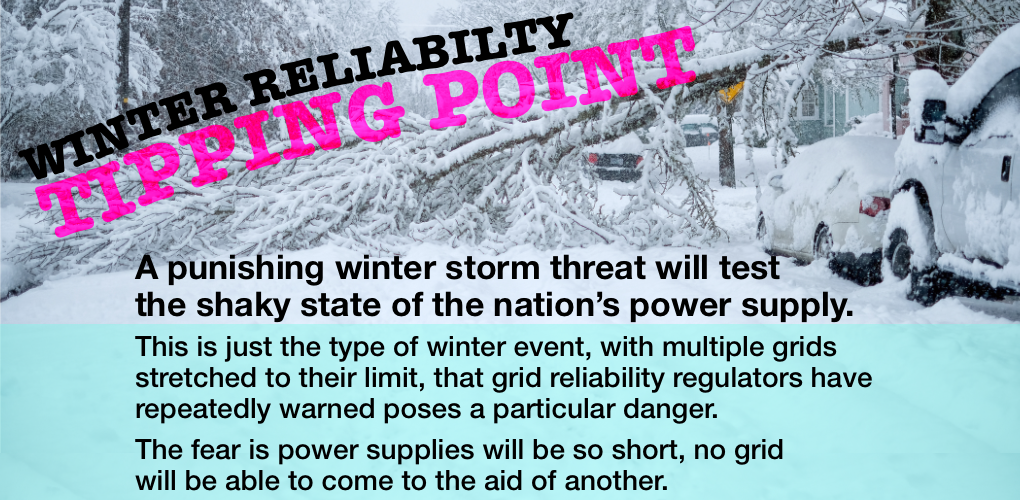
A punishing winter storm now threatens a large swatch of the country from Texas through the Mid-Atlantic, with bitter cold descending from Canada also blanketing the Midwest and Northeast. The shaky state of the nation’s power supply is going to get a most unwelcome test. This is just the type of winter event, with multiple grids stretched to their limit, that the nation’s grid reliability regulators have repeatedly warned poses a particular danger. The fear is power supplies will be so short, no grid will be able to come to the aid of another.
Jim Robb, president of the North American Electricity Reliability Corp. (NERC), did not mince words when he recently called the nation’s grid reliability a “five-alarm fire.” And NERC’s winter reliability assessment for this winter underscored his concern.
That assessment found large swaths of the country could face electricity emergencies from severe winter storms. And the states most at risk are the states where data center development has happened fastest, exactly where this storm and biting cold are headed.
NERC warned peak winter demand has jumped 20 gigawatts (GW) in just a year, and capacity additions to meet it haven’t kept up. In fact, the amount of power grid operators can expect from renewable resources was revised downward. For wind power it dropped by 14 GW.
Natural gas generation is also vulnerable. Along with concerns about pipelines and distribution systems freezing, the dual demand on gas for both heating and power generation can lead – and has led – to scarcity. Heating needs take priority over power generation during peak demand, meaning gas power plants can be left without fuel.
Underscoring Coal’s Importance
Just how will grid operators keep the power flowing? If they can navigate the challenge ahead it will likely be with a lot of skill, a bunch of luck and tons of coal.
Time and again, during winter emergencies, on grids across the country, coal generation has surged power when other sources of electricity haven’t been able to.
And that is precisely why the Trump administration has zeroed in on keeping coal power plants on the grid and stopping premature plant retirements. Through coordinated work with utilities and several emergency orders, the Department of Energy has kept 17 coal plants online over the past year that otherwise wouldn’t be available. That effort may well prove extraordinarily timely in the days ahead.
While the reliability challenge is addressed, affordability looms large, with prices up 38 % since 2020, and the years-long erosion of the nation’s grid reliability sits at the heart of the problem. Deeply unwise decisions to tear down essential generating capacity – namely coal capacity – have left the nation short of dispatchable power, short on fuel diversity and remarkably unprepared for rapidly rising power demand from electrification and the data center boom.
If we stand any chance of threading the grid reliability and affordability needle, keeping existing coal plants available – and getting far more power from them – will be essential. The week to follow might well decisively prove the point.
The path towards lower power prices and a more secure and reliable supply of power is through abundance. And the truest way to get there is to ensure that for the foreseeable future, capacity additions come on the shoulders of the coal capacity we still have, not in place of it.
- On January 21, 2026