
The Jig is Up
When is the U.S. Environmental Protection Agency (EPA) going to face the facts on the unworkable technology mandates in its so-called Clean Power Plan 2.0?
Just this week, prominent Senate Democrats Joe Manchin, D-W.Va., Chairman of the U.S. Senate Energy and Natural Resources Committee, Sherrod Brown of Ohio, Mark Kelly of Arizona, Jon Tester of Montana and Kyrsten Sinema, an independent from Arizona, wrote EPA expressing their deep concern with the mandated use of carbon capture and storage (CCS) and hydrogen in EPA’s proposed rule. The senators encouraged EPA to heed the warnings of grid reliability experts, grid operators, utilities and energy trade unions that the proposed rule is a clear threat to the nation’s grid reliability, affordable supply of power and thousands of union jobs.
They wrote:
“Recently, Congress has worked in a bipartisan manner to pass important laws advancing American innovation through promising technologies like hydrogen, carbon capture, and advanced nuclear to create additional pathways to achieve a clean energy future. Unfortunately, EPA’s recent power plant rule overestimates the current and anticipated maturity of these promising technologies, to the detriment of American workers and consumers.”
The letter adds that while the senators hope these technologies “will be available in the near future, we cannot ask our constituents to bear the cost of that risk in the form of significantly higher utility bills and unreliable electricity.”
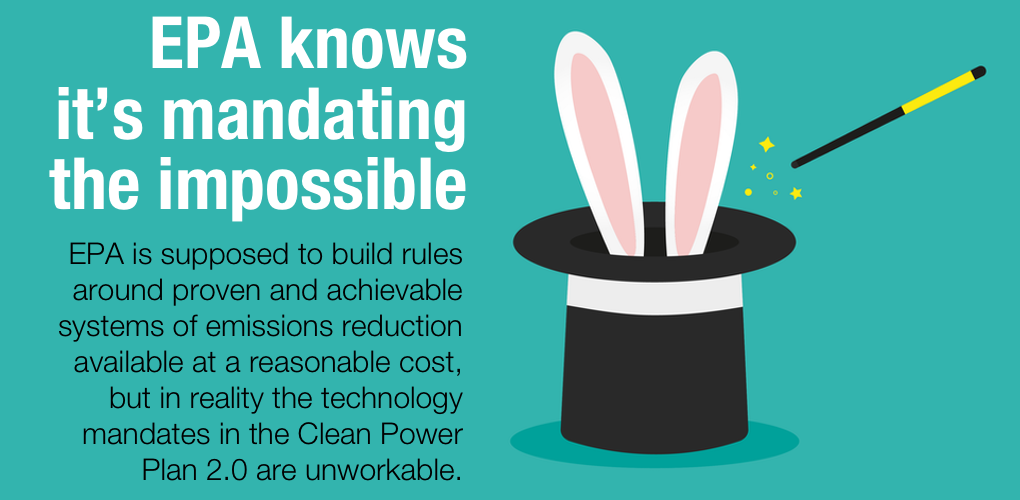
EPA Knows It’s Mandating the Impossible
What the senators could have also said is that EPA knows very well its technology mandates in the proposed rule are unworkable. Just a few weeks back, House Republicans highlighted comments from within the Biden administration making clear the technology requirements in the rule are unachievable and don’t meet the requisite standards for new emissions rules.
EPA is supposed to build rules – and set technology mandates – around proven and achievable systems of emissions reduction available at a reasonable cost, otherwise known as “the best system of emission reduction” or BSER.
The House Committee on Oversight and Accountability found that officials within the administration made clear that the technology mandates in the proposed rule simply don’t pass muster.
In one example, a member of the administration wrote, “(CCUS) has not yet met the legal threshold for being considered a BSER since it has not been adequately demonstrated. …CCUS remains prohibitively expensive even after use of funds or tax credits made available through the Inflation Reduction Act.”
The Biden EPA isn’t fooling anybody. They know well that neither CCS nor hydrogen have been adequately demonstrated and proven to be cost effective systems of emissions reduction.
In fact, less than a year ago, the administration’s go-to expert on CCS, Jennifer Wilcox, the principal deputy assistant secretary at the Department of Energy’s office of fossil energy, went on the record and told Politico many people have “misinterpreted” the data on how ready CCS is. People have drawn sweeping conclusions about its readiness at-scale based on its limited use on just one unit at a single site. DOE, for its part, is still funding demonstration projects.
Opposition to EPA’s proposed rule is widely bipartisan and understandably so. It’s a rule designed to close plants—plants the nation simply can’t afford to lose.
As power demand surges, as the challenges of integrating and relying on variable power grow more acute and as the hurdles to building new generation and enabling infrastructure remain as high as ever, EPA’s proposal is the wrong policy at the wrong time.
As Senator Manchin and his colleagues told the EPA, “We believe there is a balanced approach to achieve a clean energy future while preserving the reliability of the electric grid… Providing a realistic transition path to advanced technologies when they become available can best ensure both affordability and reliability of service.” It’s past time EPA got on board.
- On January 10, 2024