
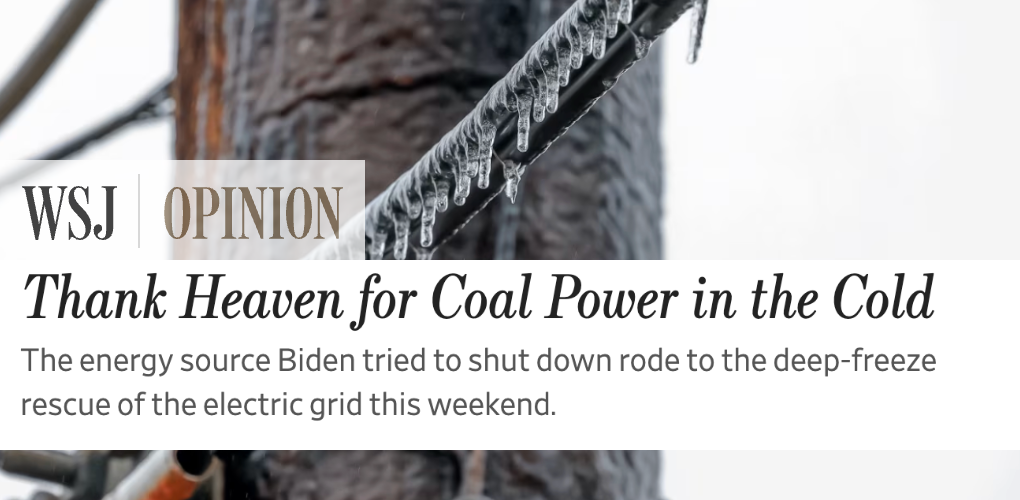
Thank Heaven for Coal and Sound Energy Policy
The Wall Street Journal hit the nail on the head this weekend in an editorial titled “Thank Heaven for Coal Power in the Cold.” Winter storm Fern has wreaked havoc across a 2,000-mile stretch of the country leaving hundreds of thousands without power. If not for coal generation, it would be millions more.
Electricity grids from Texas to New England are under immense strain and grid operators are calling for every available megawatt of power to keep the lights and heat flowing. Thanks to assistance from the Department of Energy, which issued grid emergencies for several grids allowing operators increased flexibility and resources to manage demand, we haven’t seen rolling power outages. But we’re not out of the woods yet.
Temperatures are forecast to drop further, and energy demand will be spiking, testing record levels in many states. Grid operators’ ability to avoid catastrophe so far owes much to decisions made well before the arrival of this brutal cold.
As The Journal editorial board observed, “Americans can be grateful the Biden crowd didn’t succeed in forcing all coal plants to shut down.” The Trump administration’s recognition of the nation’s grid emergency, rejection of the Biden regulatory onslaught and laser focus on keeping coal capacity available for moments exactly like this is proving exceptionally prescient.
As Secretary of Energy, Chris Wright, observed just last week, the administration has worked to keep 17 gigawatts of coal capacity operating that otherwise would have closed. With margins on so many grids so thin, that capacity is likely the difference between successfully managing this grid emergency and millions of American families being left in the cold and dark.
The Winter Energy MVP
Coal is once again proving irreplaceable during biting cold and peak winter power demand. Coal plants have repeatedly risen to the occasion to surge power on grids across the country when other sources of power cannot. Coal generation is the leading source of power on both the Midcontinent Independent System Operator and Southwest Power Pool grids, stretching across nearly 30 states from northern Texas and Louisiana all the way up through North Dakota and Michigan. Coal is also acting as a reliability backstop across PJM, the nation’s largest grid serving 67 million Americans.
PJM has said that peak demand for its 13-state footprint is expected to surpass 130,000 megawatts for seven consecutive days, a first. And it said the grid could set an all-time winter peak in demand on Tuesday, activating pre-emergency measures for several utilities to reduce electricity usage.
The costs and consequences of not having the coal fleet available are almost unimaginable. And yet, that was exactly what was happening just 12 months ago. A regulatory blitz unmoored from reality. The Trump administration’s pivot back to energy sanity is quite literally saving lives.
- On January 26, 2026