
Infrastructure – The Missing Link
Washington is now setting its fleeting sights on rebuilding infrastructure.On Monday the White House will unveil infrastructure “principles” that hopefully will add meat to the bones of the president’s initiative highlighted in his State of the Union address. This week both Senate and House committees examined aspects of energy and infrastructure. To “contextualize” this, the last time we experienced harmonic convergence on this scale we got a major tax cut.
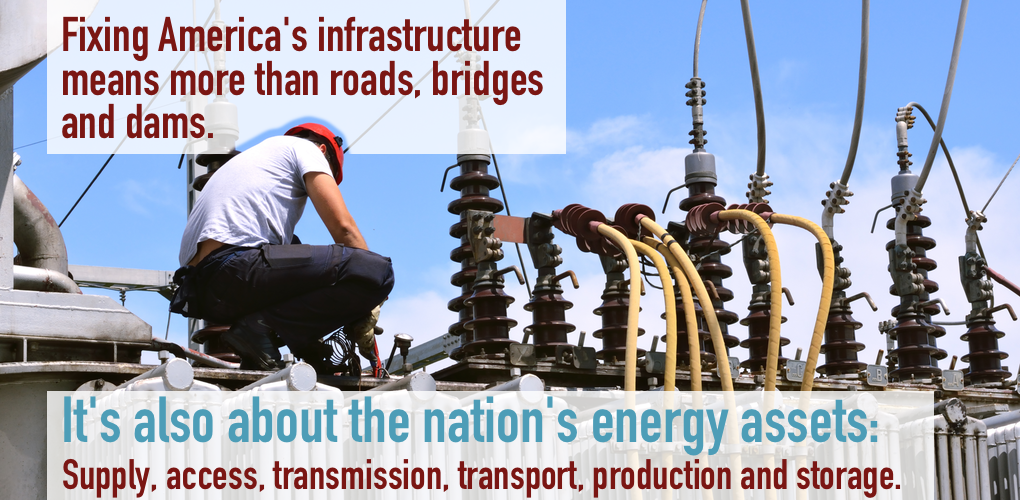
What might we expect in this case? At USEA’s Annual Energy Forum earlier this month, API’s Jack Gerard and NMA’s Hal Quinn made a good point about infrastructure: it’s about more than roads, bridges and dams. Important as these are to a well-functioning economy, infrastructure is also about the nation’s energy assets – including supply and access, transmission and transport, production and storage.
The point of giving serious consideration to energy infrastructure should by now be too obvious for even our fractious political debate to ignore. Securing reliable and affordable energy is arguably a priority second only to securing the borders from invasion. No post-industrial power can prosper and maintain its independence without on-demand energy.
While the cost of strengthening U.S. energy assets will be substantial, so will the job creation and economic benefits that voters still insist are their top priorities.
Here are some modest suggestions for strengthening an energy infrastructure now showing its age.
Fix a permitting process that makes delaying projects easier than building them. NEPA has morphed from its intended purpose, as a means of assessing environmental impacts, to a process for delaying projects through litigation. Because few NEPA assessments escape NGO litigation, federal agencies have little incentive to complete them. Result: paralysis by analysis. Federal agencies are required to assess “impacts” over which they have no authority, let alone influence – e.g. climate change “impacts” from exported U.S. coal burned in Harbin. Multiple federal agencies separately generate their own environmental assessments of the same projects. Management by Larry, Moe and Curly.
The New Source Review in the Clean Air Act is a notorious bottleneck, discouraging capital improvements that make power plants more efficient and more environmentally friendly. In NSR speak, a plant upgrade is called a “modification.” Because improving a plant’s performance may result in greater emissions, modifications trigger a lengthy NSR permit process that can make the upgrade uneconomic. A classic case of pitting “the good” in a perennially losing contest against “perfection.”
Mine permits in the Clean Water Act have been retroactively revoked with the bogus justification that “new science” invalidates them. Under NEPA, “New science,” like “more analysis,” can always be found to jam the gears. Every federal coal lease is an exercise in duplication. It requires a permit under the Mineral Leasing Act from BLM, a state agency permit under the Surface Mining Control and Reclamation Act, and a “mine plan approval” from the OSM. Can’t there be an integrated process that reduces time and costs?
Upgrade ports and inland waterways. Both coal and gas are in great demand in the world. The U.S. has enormous volumes of each – world-leading supplies of coal, some 381 years at current production rates, and a dozen year supply of gas. [BP Statistical Survey]. But the value of these resources is limited by poor access to overseas markets. New and better export terminals for coal and LNG would serve both foreign and domestic needs. The Army Corps of Engineers can improve port capacity by prioritizing dredging projects with the biggest economic payoff, getting more of the funds now sitting idle in the harbor maintenance fund appropriated for their intended use.
Demand is there. U.S. coal exports rose 61 percent last year – doubling from 2016 – to 97 million tons. For every million tons exported, 1,320 jobs are created throughout the supply chain paying $90,000 annually. Do the math. That should help offset the 4 percent drop in solar jobs in 2017 still more expected to be lost this year.
Dredging our Inland Waterways and modernizing the locks and dams that control traffic on them will help move to market 107 million tons of coal each year, almost 15% of total coal production – part of the more than 548 million tons of all commodities that travel on the Inland Waterway.
Emerging countries strive to provide energy resources for their people. This country too often strives to prevent energy resources from reaching theirs. If we can’t find bipartisan support to address energy infrastructure needs, we probably deserve to end up a vassal state of China.
- On February 8, 2018