
NERC Confirms the Crisis
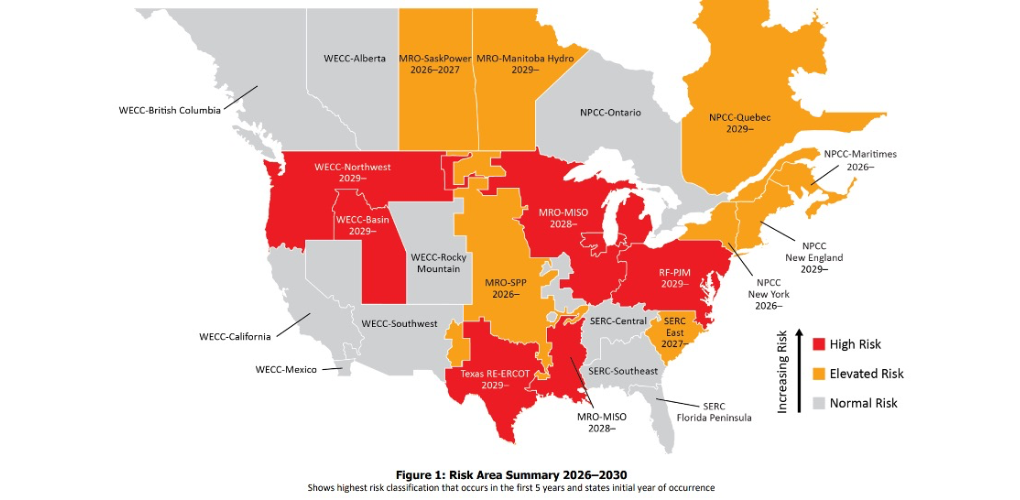
The North American Electric Reliability Corporation’s (NERC) latest long-term reliability assessment should be frontpage news. The nation’s supply of power isn’t just in crisis—it’s a rapidly accelerating crisis. The assessment is an urgent plea for emergency action to reinforce the nation’s grid reliability.
NERC found that 13 of 23 assessment areas face resource adequacy challenges over the next decade. Even that metric understates how critical the situation has become. PJM Interconnection, serving 67 million Americans, along with the MISO, ERCOT, WECC-Basin and WECC-Northwest grids are all at high-risk of energy shortfalls in just the next five years.
Rich Nolan, the National Mining Association’s president and CEO, said of the report, “This assessment should put to bed any debate about the need to keep America’s coal plants running—the era of energy subtraction must permanently be put in the rearview mirror. Federal and state policies must align to tackle this crisis and ensure our coal fleet is available to provide the fuel security and dispatchable fuel optionality that has kept the lights on and homes warm throughout the bitter cold that has gripped much of the nation over the past week.”
Nolan added, “coal plants are providing a reliability backstop on grids across the country and are the leading source of power for tens-of-millions of Americans when they need it most. The Trump administration’s embrace of the U.S. coal fleet is not only a most welcome return to energy policy sanity but a clear acknowledgement of a reliability imperative.”
NERC now expects summer peak demand and winter demand to jump by over 225 gigawatts (GW) and 245 GW, respectively, over the next decade—an amount roughly needed for 150 million homes.
The jump in projections mark a nearly 100 GW increase in just a year. NERC notes data centers, not unexpectedly, are driving the spike in demand.
The assessment not only highlights the growing mismatch between the speed at which new power demand is mounting, and the sluggish speed new generation is entering service, but how most new resources in the pipeline lack the reliability attributes of traditional dispatchable generation.
NERC also warns against further fossil fuel retirements, particularly those plants with fuel on site, noting such losses degrade the system’s ability to respond to spikes in demand. NERC adds, the “continuing shift in the resource mix toward weather-dependent resources and less fuel diversity increases risks of supply shortfalls during winter months.” That’s a timely observation considering the immense challenges faced by grids this week and the importance of coal generation in meeting spiking demand.
Coal to the Rescue
The U.S. Energy Information Administration reported that in the week ending January 25, as winter storm Fern slammed much of the country, coal generation in the Lower 48 states increased 31% from the previous week. Not surprisingly, hydro, wind and solar power all declined. No source of power has ramped up more to meet this record demand than coal. And while we don’t have all the data yet, no doubt it’s irreplaceable this week as well.
As Secretary of Energy Chris Wright told the president at a cabinet meeting this afternoon, “beautiful, clean, coal was the MVP of the huge cold snap we’re in right now. I can say with some confidence hundreds of American lives have been saved because of your leaning in and stopping the killing of coal.”
Since day one in office, the Trump administration has attacked the reliability crisis with the urgency it so clearly demands. NERC’s latest long-term reliability assessment is all the proof anyone should need proving the administration’s focus – and embrace of coal – has been right on the mark.
- On January 29, 2026