
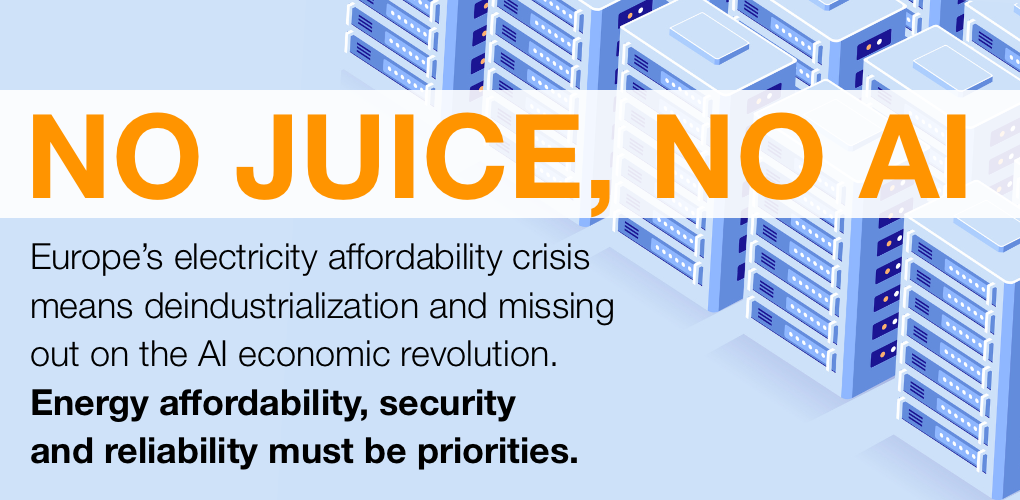
Europe’s Green Pivot is Proving an Affordability Catastrophe
Rising electricity prices in the United States – up about 32% on average over the past five years – have become an important issue for voters. Now imagine if prices had doubled. That’s the incredible reality facing Europe.
As The Wall Street Journal reports, European politicians told voters the pivot to renewables would be a win-win, slashing emissions and slashing prices. But the reality is far different. While emissions have fallen in Europe – down 30% from 2005 levels – electricity prices have surged.
According to the International Energy Agency, Germany has the highest domestic electricity prices in the developed world, and the U.K. has the highest industrial electricity rates. The average electricity prices for heavy industry in the E.U. are twice those in the U.S. and 50% above China.
The result is a massive affordability crisis for consumers and the rapid deindustrialization of long-time powerhouse industrial economies. The economic and security implications are stark. And they’re the direct product of excruciatingly painful policy missteps.
Deindustrialization and False Promises
Europe is not only losing industry thanks to its electricity affordability debacle, it’s also finding it all but impossible to attract new energy-intensive industries, like the AI data centers leading the next economic revolution.
Jerome Evans, the CEO of a German data-center operator, said he wanted to expand two data centers in Frankfurt, Germany but the local power provider told him he’d have to wait a decade, until 2035, for the energy to power them. His case is hardly unique.
Europe is short on power and long on soaring costs. Doubling down on renewable energy – as some policymakers are pushing to do – is not going to deliver the savings or energy security boosters have long promised but failed to deliver.
The extraordinary cost of building new infrastructure to accommodate renewable generation, grid-scale battery backup and managing “dunkleflaute,” the periods of cloudy, windless weather that can leave billions of euros in renewable investments all but useless, are adding up.
On January 8 of this year, Britain’s 22 gigawatts (GW) of installed wind power provided just 2.5 GW of generation during peak demand. Total power demand across Britain was almost 19 times higher at nearly 47 GW. To keep the lights on, Britain had to fire up every gas plant that could run and import every GW of power available regardless of eye-watering prices. British consumers paid £2.7 billion last year to “balance” the grid—a cost expected to hit £8 billion by 2030.
Surveys show fully half of British consumers are already planning to ration energy use this winter as they struggle with electricity costs.
Europe’s unfolding energy debacle underscores the importance of the Trump administration’s pivot away from the previous administration’s failed energy policy. Energy affordability, security and reliability, once given second billing, are now once again priorities.
As the U.S. faces soaring power demand, abundance is essential. Not only must we expand our energy systems and production to meet the moment, but we must also get even more out of what we already have. Building on the shoulders of our coal fleet – instead of casting it aside – is the critical first step to ensuring we don’t follow in the footsteps of Europe’s self-made energy crisis.
- On December 3, 2025